Twelve Colours, One Year: The Tablescape Series Comes Togethe

What began as twelve dinners built around twelve colours became something much larger than I could have imagined.
The Tablescape Series started with a relatively simple idea: to choose a colour for each month and use it as the starting point for an evening. From there, Kate Levitt and I would build a world around it. Food, flowers, music, objects, paper, lighting, wine, and the season itself would all respond to the same colour, creating a table that existed for only a few hours before disappearing again.
Over the course of the series, those colours took us everywhere.
Tomato
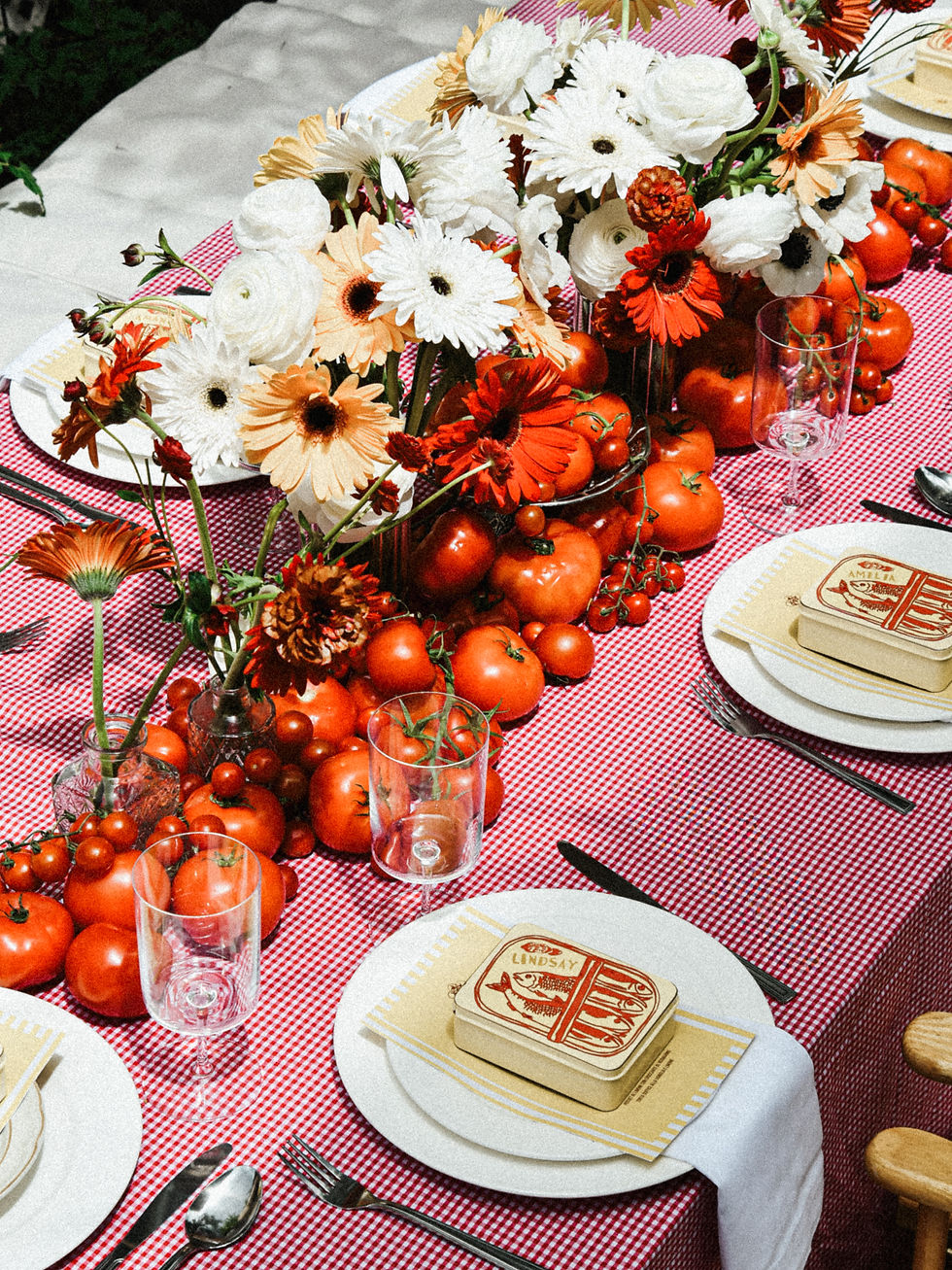
Tomato was where it began. Ripe fruit, Italian markets, gingham, terracotta, sunlight, and the imperfect beauty of an heirloom tomato made up its world. It grew from a moment in Florence when something as simple as noticing a tomato made colour feel possible again.
Here, food and colour were almost impossible to separate. Tomatoes, pasta, bread, cheese, artichokes, and produce became both meal and visual language, with the looseness and abundance of an Italian market table.
What began as an informal shoot and meal with friends became the proof of concept for everything that followed. Tomato was less about having a finished plan than rediscovering the desire to notice what was directly in front of me.
Coastal

Coastal held the nostalgia of places that are partly real and partly imagined. Faded shutters, hydrangeas, open water, weathered wood, and long July afternoons all seemed to belong to it. It carried the feeling that summer might go on forever, even while knowing that it never does.
Oysters, citrus, ice, and seafood brought that imagined shoreline closer, making the food feel tactile, fresh, and unhurried.
Patrick McMurray taught guests to shuck their own oysters, turning something usually presented finished into an experience of its own. For a few hours, the evening carried the ease of a summer day with nowhere particularly urgent to be.
Marigold

Marigold was the last golden stretch of summer. Pollen, straw, fading petals, honey, butter, sweet corn, and late-afternoon light all sat within it. It held abundance alongside the first quiet awareness that abundance would not last forever.
The menu stayed close to that late-summer feeling, drawing from ingredients at their peak. A chilled sweet corn soup captured August especially well, rich with the sweetness of the season but still light enough for summer.
James Kenny led a Bee’s Knees workshop built around tasting different honeys. It became an evening about experimentation and attention, and about how much complexity can sit inside something that first appears simple.
Aubergine

Aubergine belonged to the point where summer begins to darken. Ripe figs, grapes heavy on the vine, bruised plums, red wine, velvet, silver, and late flowers all seemed to exist within its spectrum. It felt lush, but quieter than summer, as though the season had reached its fullest expression and was beginning to fold inward.
The food and wine followed that same transition. Fig and ricotta, smoked trout, duck, blackberry, and increasingly deeper pairings carried the meal gradually from brightness toward something richer.
Divya Steinwall joined the series for wine pairings, encouraging guests to think about aroma, flavour, structure, and memory without searching for one correct answer. Wine became another way of interpreting colour rather than simply something served alongside dinner.
Ink

Ink was less about black as a colour than black as a space. Shadow, reflection, ritual, uncertainty, and the things we cannot immediately see all lived within it. Against darkness, candlelight became brighter, glass more fragile, and familiar objects somehow more mysterious.
Kate built the six-course menu around tarot’s Major Arcana, beginning with The Fool and ending with The World. Black sesame, squid ink, black garlic, charcoal, dark fruit, and chocolate moved through the cards and their elements.
Between courses, guests disappeared behind curtains one by one for tarot readings. The evening became less about finding answers than becoming comfortable with what had not yet revealed itself.
Terracotta

Terracotta carried the warmth of things made by hand. Clay, old tiles, worn vessels, pigment, earth, and objects made more beautiful through use all belonged to it. The colour seemed to contain evidence of where something came from and the person who shaped it.
Food was served generously in bowls and platters, meant to be picked up, passed around, returned to, and eaten while guests moved through the space.
The evening extended beyond the table into a salon-style gallery filled with work by artists and makers. Art, objects, food, and hospitality were allowed to exist together, each carrying the mark of the person who made it.
Evergreen

Evergreen was winter endurance. Pine and fir holding their colour while the rest of the landscape faded, familiar rooms glowing against early darkness, and rituals repeated year after year all belonged to it. It carried home, family, tradition, and the strange resilience of continuing to celebrate through difficult seasons.
The meal was deliberately familiar and generous. Turkey, polenta, roasted vegetables, warm rolls, cranberry, clementine, and dessert served family-style belonged to the kind of food people return to each winter.
Music became the experience beyond the table, with Gabrielle Byrnes and Dunstan Morey bringing winter songs into the room. Evergreen became less about reinventing tradition than understanding why certain rituals are worth returning to.
Ivory

Ivory was quiet, but never empty. It belonged to winter light, softened linen, candle wax, paper, and the first signs of something beginning beneath the surface. More than white, it carried warmth and possibility: the feeling of making space before knowing exactly what will fill it.
Kate carried that restraint into the menu through parsnip, pear, browned butter, halibut, cream, and meringue. Pale and distinctly winter, the food found warmth inside a limited palette.
The snowdrop became the symbol of the evening, a flower that emerges before winter has fully released its hold. Guests built a bouquet gradually through the courses, turning the idea of beginning again into something that physically grew over the course of dinner.
Crimson

Crimson arrived with confidence. It was velvet curtains, lipstick, cinema, martinis, candlelight, and the particular glamour of choosing not to disappear into the background. There was something theatrical about it, but also assured.
The menu leaned into indulgence through tomato, red wine, rich sauces, cheese, dark fruit, and a raspberry dessert made to be shared. It was the kind of food that encouraged another glass and another hour at the table.
A martini fountain greeted guests at the door while films played throughout the evening. Around the table, Crimson opened conversations about glamour, confidence, femininity, visibility, and the pleasure of allowing yourself to be noticed.
Espresso

Espresso turned inward. Brown carried earth, coffee, bark, mushrooms, soil, worn wood, and all the quieter materials that tend to sit beneath brighter things. It became a colour about roots, process, inheritance, and the foundations that support us without demanding attention.
The food was similarly grounded. Mushrooms, caramelized onion, root vegetables, black garlic, browned butter, maple, and espresso created depth without relying on brightness.
A forest therapy experience slowed the evening down and brought guests back to memories of soil, gardens, cottages, family, land, and time spent outdoors. Espresso became a reminder of how much of what shapes us exists quietly beneath the surface.
Lavender

Lavender was softness with movement in it. It began with gardens and the romance of Provence, but eventually became something freer: summer air, friendship, long evenings, music travelling across a lawn, and conversations that formed without anyone directing them.
Food moved through the evening rather than dictating it. There were no assigned seats or formal courses, and guests wandered between a grazing table, cocktails, flowers, and one another.
After the series had paused, Lavender returned in a completely different space from the one originally imagined. It became proof that the project could move, adapt, and be carried by other people without losing what made it meaningful.
Pistachio

Pistachio felt like new growth just before summer becomes dense and unruly. Young grass, tender herbs, pale leaves, golf courses, greenhouses, and gardens after rain all seemed to sit inside it. Fresh but muted, it existed somewhere between cultivation and wildness, order and everything that refuses to be controlled.
The final menu was bright with summer: zucchini, mint, melon, sweet corn, basil, pistachio, peach, and wines that moved from crisp mineral whites and sparkling wine into something deeper before ending with Sauternes.
Then the rain arrived. Torrential downpours enclosed the tables beneath chiffon while plates and bottles travelled beneath umbrellas and the garden remained visible beyond them. After a year of carefully constructed evenings, the final table became the right ending: thoughtfully imagined, completely altered, and better for having surrendered some control.
Looking back at the twelve together, I can see how far the original premise travelled. A colour became a way into a season, an ingredient, a room, a memory, a person, a place, or a question I had not known I was asking.
At almost every dinner, guests were eventually asked some version of the same question: what does this colour mean to you? The answers rarely remained about colour for very long. Someone would remember a grandmother’s house, a childhood landscape, a family tradition, a trip taken years earlier, or a person they missed.
That became the foundation of The Tablescape Series: Stories of Colour. The book brings all twelve colours together through photographs and essays, alongside Kate’s menus and recipes, playlists, wine pairings, and the many details and collaborators that shaped each dinner.

On Saturday, October 3, that story will come together in another form. The Tablescape Series: The Finale will transform DesignAgency in Toronto into an immersive celebration of all twelve colours, with food, wine, music, installations, collaborators from throughout the series, and the official launch of The Tablescape Series: Stories of Colour.
The Tablescape Series began with colour, but somewhere along the way it became equally about attention: noticing a season, a room, an object, a meal, the person sitting across from us, and the memories held inside things we might otherwise pass without seeing.
Twelve colours. Twelve tables. One complete story.
The Tablescape Series: The Finale
Saturday, October 3, 2026
DesignAgency, Toronto


Comments